After the test
Handling penetration test false positives
Penetration test false positives are findings that turn out not to be real. They cost engineering time and make a report harder to trust. So a buyer needs a simple, written way to challenge a finding and close the question.
- Signed written scope first
- Senior ethical hackers only
- Your NDA signed as standard
Why penetration test false positives happen
Most come from automated output that nobody checked by hand. Others come from a misunderstanding of how a system is meant to work. In both cases, the finding was recorded without proof.
Therefore the best prevention is in procurement. Choose a firm that verifies each finding manually and shows the evidence.
How to dispute a finding
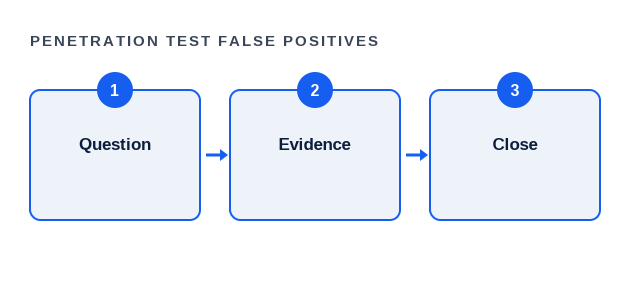
Write down the finding, why you believe it is wrong and what evidence you have. Then send it to the named lead, not a general inbox.
Also set a short deadline for the reply. Because fixes are waiting, the question should not stay open for weeks.
| Step | Who acts |
|---|---|
| Written challenge with evidence | Your system owner |
| Review of the original proof | The named lead |
| Written outcome | The named lead |
| Report update if needed | The firm |
| Record in the vendor file | Your security lead |
Penetration test false positives review
Tick what your agreement already covers.
Your result appears here as you tick, so you can see what is still open.
Evidence to ask for
Every finding should carry enough detail to show it was confirmed. That means what was observed, when, and why it matters. If that detail is missing, ask for it.
However, the evidence should be shared only with named contacts. A dispute is not a reason to circulate sensitive detail widely.
Closing penetration test false positives in the report
When a finding is withdrawn, the report should be updated, not just annotated in an email. Then auditors and customers see the corrected version.
Similarly, if the finding stands, record why. As a result, your team does not reopen the same question next year.
Contract terms that help
Agree in advance that disputed findings are reviewed in writing within a set number of working days. Also agree that a corrected report is issued at no extra fee.
Because the rule exists before the test, nobody negotiates it under pressure.
How we reduce penetration test false positives
We prove chains rather than listing noise, so every step is reproducible. The ethical hacker who ran the test writes the report and answers questions about it directly.
Full engagements usually land between $35,000 and $120,000, with a floor of $25,000. The bounded External Exposure Review starts at $4,500, and its fee is credited in full against a full engagement commissioned within ninety days. Every fee is fixed after a written scope, so there is no hourly billing. The method follows the Penetration Testing Execution Standard.
Penetration test false positives questions
Are penetration test false positives common?
They are common in tool-driven work. Manual verification reduces them sharply.
Who decides a disputed finding?
The named lead reviews the proof and answers in writing.
Should the report be reissued?
Yes, so auditors and customers see the corrected version.
Can contract terms limit penetration test false positives?
They set a review deadline and a free correction.
Related guides
Avoid penetration test false positives from the start
Send a short brief. We reply with a written scope, the named lead and a fixed fee.
Request a written scope