Engagement note
How a penetration testing retainer works
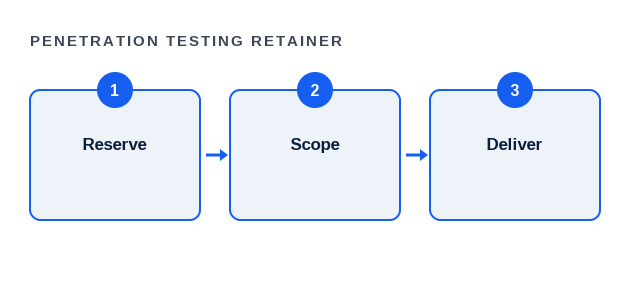
A penetration testing retainer reserves a firm's time across a year instead of buying one test at a time. It suits teams that release often or face regular customer reviews. However, every piece of work under it still needs its own written scope.
- Signed written scope first
- Senior ethical hackers only
- Your NDA signed as standard
When a penetration testing retainer makes sense
Some organizations test once a year, and a single engagement fits them well. Others ship major changes every quarter, or answer customer security reviews every month. For them, booking each test separately adds delay.
So a retainer trades flexibility for continuity. The same senior people learn your estate, and each new engagement starts faster.
What a penetration testing retainer agreement covers
The master terms are signed once: confidentiality, data handling, liability, invoicing and the named lead. Then each piece of work is added as a short written scope under those terms.
Because the heavy paperwork is done once, later engagements move quickly. However, authorization is never assumed. The system owner still signs each scope.
| Part | Signed when |
|---|---|
| Master terms and NDA | Once, at the start |
| Named lead and team | Once, with approval for changes |
| Scope for each engagement | Before each piece of work |
| Owner's authorization | Before each piece of work |
| Report and retest | After each piece of work |
Penetration testing retainer readiness
Tick what your calendar already shows.
Your result appears here as you tick, so you can see what is still open.
Fees under a penetration testing retainer
Each engagement still carries a fixed fee, agreed after its scope. So the retainer reserves time rather than creating hourly billing.
In addition, agree in writing what happens to unused time at year end. Because both sides know the rule, the last quarter does not turn into a rush.
Scheduling and change
Agree a planning rhythm, such as a short written review each quarter. Then upcoming releases, audits and customer deadlines can be matched to test dates early.
Also agree how urgent work is requested. A written request with a short scope keeps even fast work properly authorized.
When a penetration testing retainer is not the answer
If you test once a year, a retainer adds terms you do not need. Similarly, if you want a fresh firm each year for independence, a long commitment works against that.
So start with the release and audit calendar. If it shows several testing moments a year, a retainer usually pays for its paperwork.
How we work on retainer
We work with security teams on retainer and on named engagements. Either way, a named senior ethical hacker leads the work, we sign your NDA first, and nothing is retained after delivery.
Full engagements usually land between $35,000 and $120,000, with a floor of $25,000. The bounded External Exposure Review starts at $4,500, and its fee is credited in full against a full engagement commissioned within ninety days. Every fee is fixed after a written scope, so there is no hourly billing. The method follows the Penetration Testing Execution Standard.
Penetration testing retainer questions
Does a penetration testing retainer mean hourly billing?
No. Each engagement still has its own fixed fee after scoping.
Is authorization signed once under a penetration testing retainer?
No. The system owner signs each scope before each piece of work.
Who leads the work?
A named senior lead, approved by you, across the year.
Can a penetration testing retainer be ended?
The master terms should say how, in writing, before you sign.
Related guides
Plan a penetration testing retainer in writing
Send your release and audit calendar. We reply with draft terms, a first written scope and a fixed fee.
Request a written scope