Vetting note
How to judge a redacted penetration test report
A redacted penetration test report is the closest thing to a test drive. It shows real work with the client's details removed. So before you hire anyone, ask for one, and read it the way your engineers and board will.
- Signed written scope first
- Senior ethical hackers only
- Your NDA signed as standard
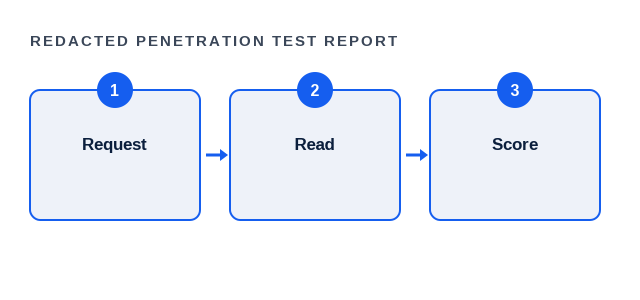
What a redacted penetration test report should show
The structure should survive redaction. You should still see a summary, a list of findings, the risk of each one and a clear fix. Only names, addresses and identifying details should be hidden.
Also look for dates and scope notes. Because a report without scope is hard to trust, a good sample says what was tested and what was not.
Scoring a redacted penetration test report
Use the same short scorecard for every firm. Then the comparison is fair, and you can file it with the procurement record.
In addition, ask an engineer and an executive to read the same sample. If both understand their part, the report works for your whole organization.
| Area | What good looks like |
|---|---|
| Summary | Plain words a board member can follow |
| Findings | Linked into chains, not a flat list |
| Risk | Business impact explained, not just a score |
| Fixes | Specific and ordered by priority |
| Scope note | What was in and out, in writing |
Redacted penetration test report scorecard
Tick what the sample in front of you shows.
Your result appears here as you tick, so you can see what is still open.
What redaction should hide
Names, domains, addresses and anything that identifies the client must go. Similarly, details that would let a reader repeat the work against that client should be removed.
So if a sample still shows identifying detail, treat it as a warning. The firm would handle your report the same way.
Red flags in a redacted penetration test report
A sample that looks like a tool export, with hundreds of generic items, suggests little manual work. Also watch for findings with no fix, or fixes that say only to update everything.
Finally, check who wrote it. If nobody can name the author, you cannot know who will write yours.
Using the redacted penetration test report in your contract
Once you choose a firm, refer to the sample in the agreement as the expected format. Then the final report has a standard to meet, and both sides know what was promised.
Because the format is fixed in writing, disputes about quality become simple comparisons.
Our sample
We share a redacted report from an authorized engagement, written by the person who ran the test. Then a complimentary retest follows once you have fixed what we found.
Full engagements usually land between $35,000 and $120,000, with a floor of $25,000. The bounded External Exposure Review starts at $4,500, and its fee is credited in full against a full engagement commissioned within ninety days. Every fee is fixed after a written scope, so there is no hourly billing. The method follows the Penetration Testing Execution Standard.
Redacted penetration test report questions
Will any firm send a redacted penetration test report?
Most careful firms will. If one refuses, ask why.
What should a redacted penetration test report hide?
Anything that identifies the client or would let the work be repeated against them.
Who should read the sample?
One engineer and one executive, using the same scorecard.
Can a redacted penetration test report go in the contract?
Yes. It can set the expected format of your final report.
Related guides
Request our redacted penetration test report
Send a short brief. We reply with a redacted report, a written scope and a fixed fee.
Request a written scope