Service
ServiceNow penetration testing for the instance you configured
ServiceNow penetration testing checks how your instance protects the records it holds. So it covers access controls, portals, custom scripts and the integrations that feed it.
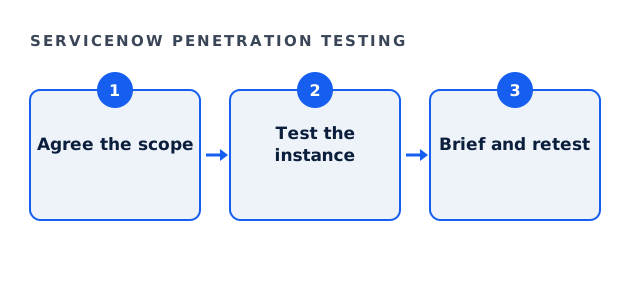
- Signed written scope first
- Senior ethical hackers only
- Your NDA signed as standard
Why ServiceNow penetration testing matters
Because ServiceNow often holds HR cases, IT assets and customer requests, the stakes are high. Therefore a weak access rule can expose sensitive records to the wrong people.
Customisation also grows over time. In addition, scripted endpoints written for one integration may stay open long after it ends.
What ServiceNow penetration testing examines
The test treats each access rule as a promise. For example, can a requester read another person's case?
- Access control lists on tables and fields
- Service portal pages and widgets
- Scripted REST APIs and integrations
- Roles, groups and elevated privileges
- Guest and self-service access
ServiceNow penetration testing readiness check
Tick what is already true.
Your result appears here as you tick, so you can see what is still open.
Rules for ServiceNow penetration testing
ServiceNow sets its own process for customer-initiated testing. So we follow its current requirements, and testing targets your instance only.
| Topic | Approach |
|---|---|
| Instance | Sub-production preferred |
| Authorisation | Your signed scope, plus the vendor's process |
| Availability | No load or denial-of-service testing |
| Accounts | Test users for each role |
What you receive
A senior ethical hacker briefs you on each finding, with evidence and a fix. Also, a retest confirms what changed. Vendor material is on the ServiceNow Trust Center.
Your NDA comes first, and nothing is retained after the engagement closes.
Fees
Full engagements usually land between $35,000 and $120,000, with a floor of $25,000. The bounded External Exposure Review starts at $4,500, and its fee is credited in full against a full engagement commissioned within ninety days.
Also review scripts after each upgrade. Because platform upgrades can change default behaviour, custom code may act differently afterwards. So a short review after each release keeps access rules honest. In addition, remove integrations nobody owns, because unused endpoints are easy to forget. As a result, the instance stays tidy between tests.
ServiceNow penetration testing questions
Does ServiceNow allow ServiceNow penetration testing?
Customers can test their own instances by following ServiceNow's process.
Should ServiceNow penetration testing use production?
A sub-production clone is usually safer.
What does ServiceNow penetration testing usually find?
Access rules that are too broad, and custom endpoints left open.
Is a retest included?
Yes. A retest confirms the fixes.
Related guides
Scope your ServiceNow penetration testing
Tell us which modules and portals you run. We reply with a written scope and a fixed fee. Also mention whether you run a public portal, because it changes the scope.
Request a written scope